110515 – The geiger-counter

It is always good to have a geiger-counter, a tool to measure ionizing radiation. I have a geiger-counter from Imagesco:
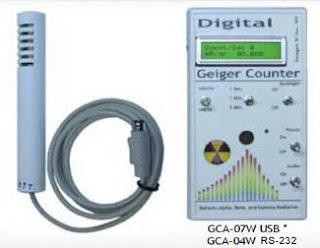
http://www.imagesco.com/geiger/digital-geiger-counter.html

But I think there is something wrong with it, because some times it wouldn’t react on high radiation. So I plan to buy this one, a gamma-scout:
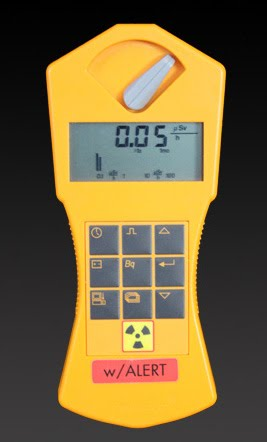
http://www.gammascout.com/
But due the nuclear accident in Fukushima, Japan, the company has gain too many orders, so it would take time to get one.

Once I borrowed a very, very expensive geiger-counter from a hospital. It was very accurate, but it costed about $ 12 000.

Radiation can be measured in many ways. Here is a simple explanation of the different units.

Decaying

Bequerel
One decay per second is 1 Bq, it is the standard unit for decaying.

Curie
Curie is an older unit. 1 Ci is 3,7 x 10^10 Bq, which be equivalent to the decay of 1 gram of Radium.


Exposition

C/Kg
Coulomb per kilo. Coulomb is a measure of electrical charge. 1 coulomb is the charge of by one second passes a conductor with the current of 1 ampere.

Roentgen
Roentgen (R) is an older unit, which be equivalent to 0,000258 C/Kg


Absorbed dose

Gray
1 Gy is one joule per kilo. One joule is equivalent to move one coulomb, one meter with one volt.

Rad
Rad is an older unit, 1 rad is 0,01 Gy.


Equivalent dose

Sievert
1 Sv is absorbed dose (in gray) multiplied with the quality-factor. The qulity factor is, for;
α-radiation = 20
β-radiation = 1
γ-radiation = 1
n-radiation = 5-20 depending on the energy

Rem
Rem is an older unit, 1 rem is equivalent ro 0,01 Sv.
110514 – Introduction

My project is to build a working nuclear reactor. Not to gain electricity, just for fun and to see if it’s possible to split atoms at home. I would be a breeder reactor, and my primary goals is to carry out two main reactions, which is;

Th-232 + n →Th-233 (T½ = 22,3 min) → β → Pa-233 (T½ = 27 days) → β → U-233
U-233 has a T½ of 1 590 000 years, and is fissionable.

And the second reaction;

U-238 + n →U-239 (T½ = 23,45 min) → β → Np-239 (T½ = 2,356 days) → β → Pu-239
Pu-239 has a T½ of 24 110 years, and is fissionable.


Some basic nuclear-physics

Th = Thorium, a naturally occuring element, atomic-number 90, and it is a weak α-emitter (the Th-232).
Pa = Protactinium, atomic-number 91.
U = Uranium, is also a naturally occuring element. Atomic-number 92. The most common isotope is U-238, wich is a weak α-emitter.
Np = Neptunium, atomic-number 93
Pu = Plutonium, atomic-number 94, the isotope Pu-239 is fissionable, and extremly poisonous.

With fissionable isotopes, you can also build nuclear weapons. But that needs huge amounts of the material, 6 kg of Pu-239 or 50 kg of U-235. In this experiment, we only will be able to produce less than a gram.

T½ stands for half-life. Every radioactive isotope has a half-life, and with thats means the time it takes for half of the atoms in the piece to decomposition to another isotope, with emitting their radiation. It can be between nanoseconds to billions of years.

Many of the substances we are going to handle is radioactive. And you should be careful with radiation. The radiation-types are;

α-radiation, contanis of 2 protons and 2 neutrons, it reaches some centimeters in air, and does not penetrate the skin. But it is very dangerous to ingest or inhale it! An α-decaying atom loses 2 in atomic-number, and 4 in total mass.

β-radiation endures of electrons and reaches some meters in air or is stopped by a glass or plate. A β-dacaying atom raises the atomic-number with 1, but the total mass is unchanged (a neutron is transforming into a proton).

γ-radiation is high-frequency electromagnetic radiation (photons), it reaches several meters but can be stopped by a thick concrete wall. γ-radiation occurs more or less in every decays.

Tillfälligt nere…

https://www.viska.nu utsattes för en spamattack, jag jobbar på att lösa det.

Har kontaktat supporten där sidan ligger o hoppas på att få igång det så fort som möjligt.